
We started off this class by discussing about the various types of binding. After a thorough explanation, I referred to studentbookbinding.co.uk to look up at different binding option, how they look and how do they differ from each other.
Saddle stitch binding :
Saddle stitch binding is a type of binding in which folded papers are put one above another and then staples through the folded line with wire staples creating a booklet. These wires pass through the folded crease from the outside and are clinched between the centermost pages. This type of binding are usually not recommended for a large amount of pages. The problem with saddle stitch is that the pages not align properly and there are chances of the pins coming out if there are many pages.
Perfect binding :
Perfect binding is a type of binding which doesn’t involve folding the pages. The inner pages are gathered together and glued along the spine with the cover applied at the same time. When the adhesive dries the pages are secured firmly in place. This type of binding is recommended for a large number of pages but I think perfect binding looks neater and the pages stay aligned. It is extremely important to keep a gutter margin in the internal edge of a page so that the text is visible.
Both saddle stitch and perfect binding are ways to professionally present brochure, catalogue, magazine, newsletter or book.
Wire binding :
Wire binding is also known as wiro/ double loop binding is a type of commercial book binding method in which the user has to punch hole in a paper(with the machine) and then insert these punched pages onto a “C” shaped spine and then use a wire closer to squeeze the spine until it is round. I think it is more sophisticated(for formal use) in appearance as compared to a spiral bind and also produces a more impressive document than a spiral bind. This binding allows a 360 degree rotation of the pages.
The more pages the book has, the larger the wire gauge and vice versa. Wire binding uses a metal wire as binding.
Spiral binding :
Spiral binding is the process of binding pages together with a plastic coil that is inserted into holes along the edge of pages. I think as compared to wire binding it is more durable but sometimes it becomes difficult to turn the pages. Spiral binding uses a plastic coil as binding.
Spiral binding and wire binding are an excellent choice for reports, directories, cookbooks, music books, instructional books, catalogs, wall calendars and maintenance manuals. I would always prefer a wire bind over a spiral bind simply because it look more neater and it’s easier the turn the pages.
Cased-in wiro binding :
If one wants to hide the wire that is visible in wiro binding from the outside there is a solution known as a Cased-in Wiro.
Kettle stitch binding :
Kettle stitch binding is a binding in which a knot is tied in the thread that links one section to the next. Kettle stitching looks like a series of knots joined together in a row. It is made of printed folded sheets which are then sewn together.
We were asked to find the difference between kettle stitch binding and Coptic binding. Here are some differences that I’ve found.
Kettle stitch’s roots lie in Medieval times. Coptic stitch was developed by early Christians in Egypt, the Copts, and used from as early as the 2nd century AD to the 11th. Kettle stitch starts from outside to begin with even number hole whereas in Coptic binding the number of hole can be odd or even number and it starts from inside. The pattern in kettle stitch binding is obviously different compare to Coptic Stitch as it needs cotton tape, satin ribbon or leather strap to clamp all the section together. In Coptic binding a thread or cotton cord are used and it passes each hole twice. Kettle Stitch and Coptic binding both can be laying flat without risk of damaging the spine; following the opening of a book past flat 180 degree. Coptic binding is a non adhesive form of binding.
Kettle stitch requires 3 to 5 sheets of paper being fold in order to create one section. Coptic binding are especially useful for binding many sections together.
Pamphlets :
The pamphlet stitch is a simple way of binding folded pages, often as an alternative to stapling. It uses a single section and is sewn with a running stitch down the spine. I think a pamphlet leaves us with a more polished and elegant look than a simple saddle stitch.
Japanese :
This is useful for binding single sheets of paper.Japanese style binding is used for large or landscape format books as the binding requires a large margin. In this binding, the thread can be used to create a pattern on the inside/outside of the book. According to me, this binding looks very pleasing to the eye and I think it’s strong enough for a less number of papers.
Screw post binding :
This binding has metal rods that can be threaded through your documents to produce great-looking books. Screw posts are easy to use, affordable and durable.
These were some of the research I did on different types of binding. For more examples I also referred to ‘mybinding.com’.
Exploring different types of binding was fun and we got ideas about which bindings can be used on which type of paper and which bindings could be used for our booklets. I thought of either using a simple saddle stitch, perfect binding or a pamphlets.
In the second half we worked on our layouts. I first started to figure out what elements of my essays do I want to put in my layouts. I thought of keeping it very direct and literal because I think an abstract thing will just be distracting for people which will in turn distract them while reading the essay. Also, I wanted people to get the essence of my essay by just looking at my layouts.
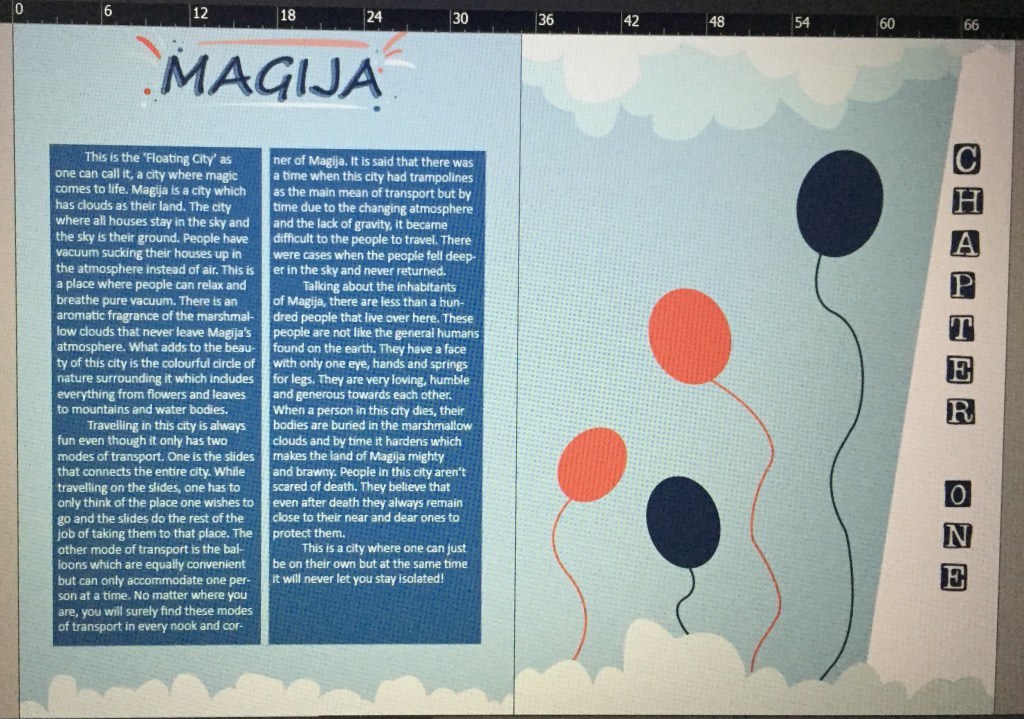
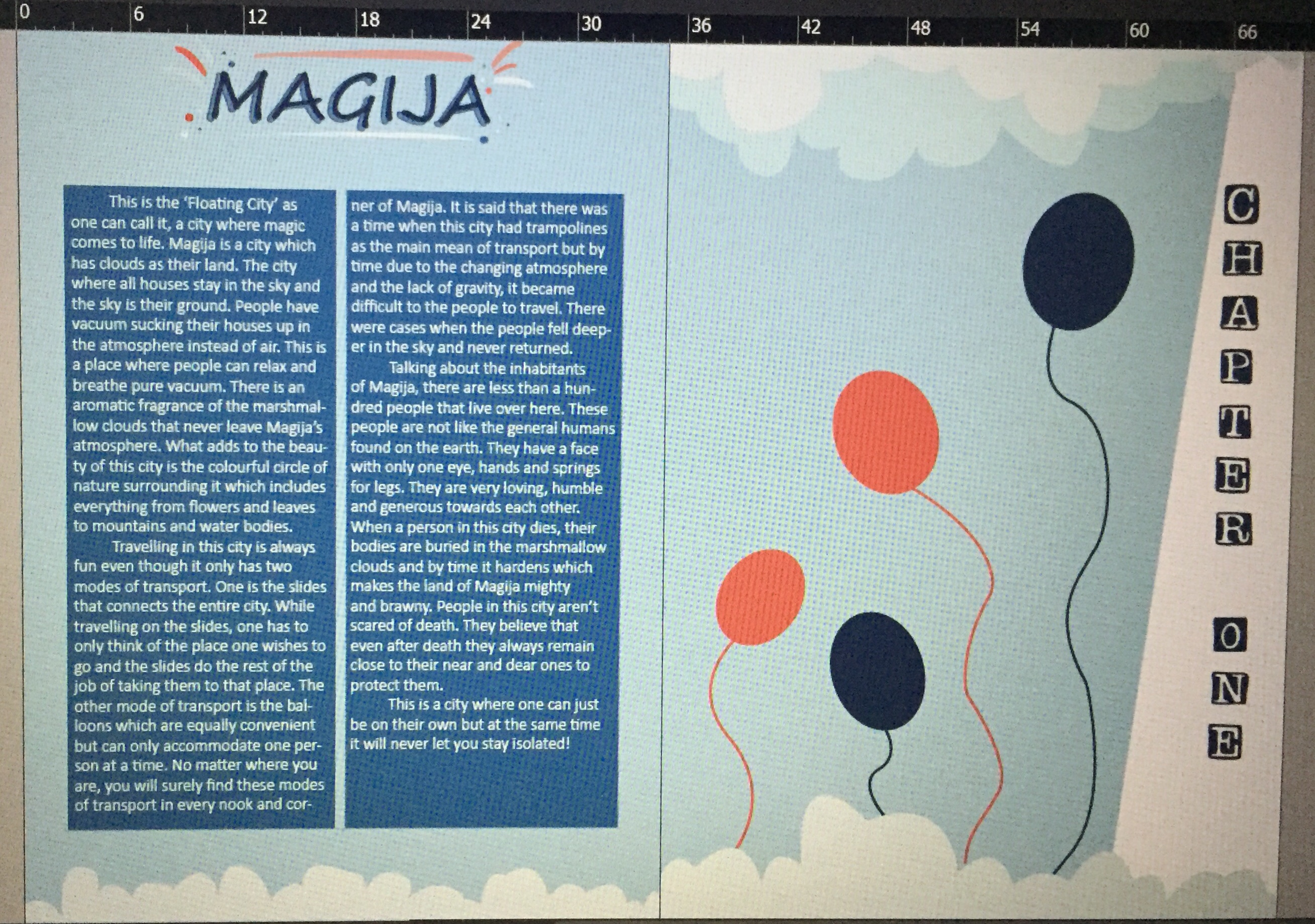
For this layout, I illustrated the balloons on illustrator and then copied it on indesign. Even the name of my city was illustrated on illustrator and then copied on indesign. I decided to go for this simple layout because my city was about the city of clouds and the main aspect in this essay was transport which was the balloons. The name of my city was ‘BESPIN’ which was taken from the cloud city of Star Wars but sir wasn’t happy with this name so I changed it to ‘MAGIJA’ which is a Croatian word for magic. The typeface that I took for my city was minion pro. I added little sparks that represent magic around it.

 AYUSHI JAIN