
We started off this class by discussing about our next project. In the start we just spoke about what was expected to be done and then the group were made. We were asked to document all our process work(writings,photos,videos,etc).
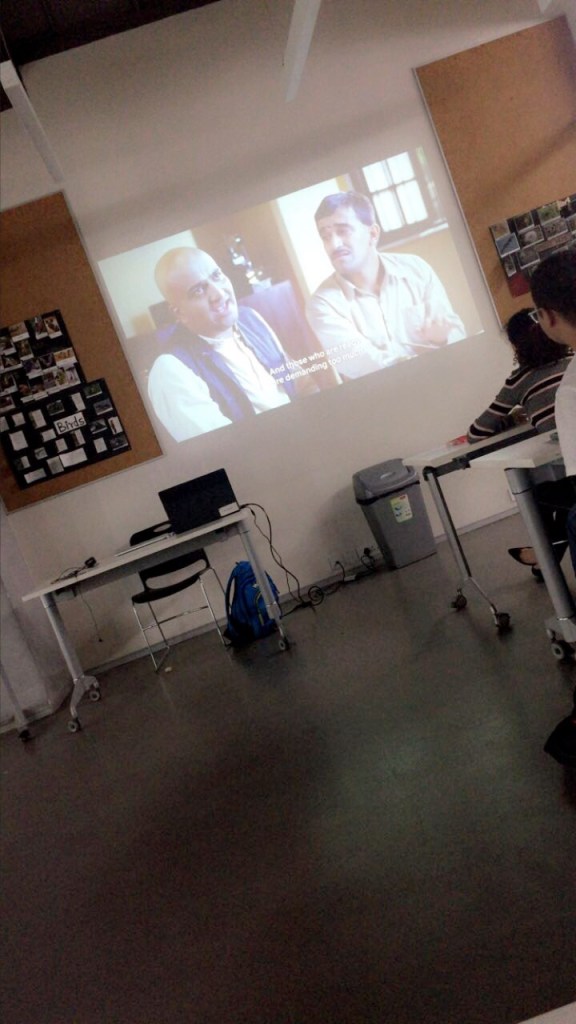
In the second d half, we saw the movie ‘Harishchandrachi Factory’. I already watched this movie before so I knew what to expect from it. It is a Marathi film that tells the story of Dadasaheb Phalke, often referred to as the father of Indian cinema, and how he came to make the first Indian film in 1913.
Dadasaheb Phalke accidentally discovers a tent screening a silent movie and is amazed by the idea of storytelling. After a lot of hurdles, he brings together a team of technicians to produce India’s first feature film.
We had a thorough discussion about the movie on various aspects like narrative, story, characters, plots, metaphors, symbolism, recurring themes, dialogues, languages, lyrics, song, music, poetry,our opinions,understanding, lenses, cultural aspect, reflections, etc.
Firstly I loved the character of Dadasaheb Phalke. He was so dedicated and passionate towards his work he didn’t back out even after his orthodox neighbours and people all around him kept on discouraging him. He was so determined to do something revolutionary for his own country than just earning money.His entire family supports him throughout the entire journey of ups and downs in creating this legacy. He leaves his family to study film making in London even after knowing that his wife is going to give birth to his child. That was his level of dedication to make films in India. I think because of this dedication Indian Cinema is as dynamic as it is today. One thing I learned from this is that if you believe in yourself you can achieve anything. If you’re confident of what you’re doing, people around you shouldn’t affect you. Even after so many hurdles Taramati and Phalke never get discouraged or sad, they find fun in everything. I think it is very important to share the little moments and find love and happiness in them. Their characters are very optimistic. From the neighbours’ point of view I think they are very narrow minded and not ready for a change. Also maybe that’s because they don’t know that something like moving pictures actually exists. They are so bounded in superstitions and customs that they believe that Phalke’s eyes got spoilt not because of stress but because of some black magic done by the britishers. A very sensitive topic that this film touched upon was poverty. The actors that are taken for the film don’t want money but the only thing they ask for is a two-time meal. This shows that at that time also there was poverty in India. It also touches upon various superstitions like if a man can only cut his moustache when his father dies and if they shave it, their father will die. Culture was a very important aspect that was captured in the film. When Phalke needs money to travel to London, no one is ready to lend him some because he doesn’t have anything to keep for mortgage and I think it’s also because people are unaware of what moving pictures is and thinks that whatever he’s doing is going to be a fail. The film has this one boy who is dancing on the streets while shouting ‘Tilak is free’ and doesn’t care about the police arresting him. That was the respect, support, love and affection Lokmanya Tilak got by the people of India. I also saw that women consider prostitution more respectful than acting in a film. Phalke keeps a harmonium player in his rehearsal hall so that the actors can get in the mood and act. This shows how music affects us.
These were some of the points we touched upon.
The era that I got was 1961-1980. We were told to watch Sholay, chitchor, grihpravesh, mriagaya, manthan. For the next class we were expected to watch all of them and make our mind maps for the same.

 AYUSHI JAIN